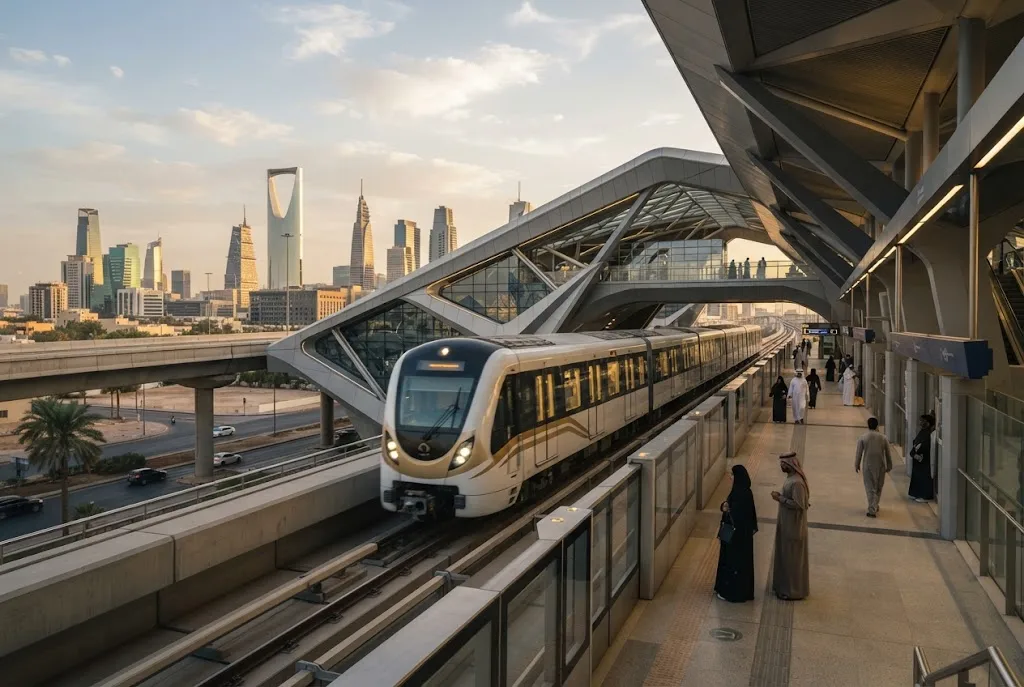
The Riyadh Metro opened in late 2024 and changed how the capital moves. It is the longest driverless metro network in the world, with six lines, 85 stations and trains that run through the city without a driver on board. For visitors and new residents, it is also the easiest way to cross Riyadh without a car. This guide explains how to ride the Riyadh Metro: the lines, the stations, the Darb card, fares and the practical details that first-time riders need.
The focus keyword is Riyadh Metro, and the guide is written for someone standing in a station for the first time, ticket in hand, wondering which platform to take. Keep it on your phone for your first few trips.
The Six Lines at a Glance
The network has six lines, each identified by a number and a colour. The Blue Line, Line 1, runs north to south along Olaya Street, the city’s main commercial spine. It connects the northern districts to the King Abdullah Financial District, Olaya, and the southern neighbourhoods, and it is the line most visitors use first.
The Red Line, Line 2, runs east to west along King Abdullah Road. It links the airport direction to the western districts and crosses the Blue Line at the main interchange stations. The Orange Line, Line 3, runs along Madinah Road and serves the western side of the city. The Yellow Line, Line 4, connects King Khalid International Airport to the city, which makes it the most useful line for arriving travellers.
The Green Line, Line 5, runs along King Abdulaziz Road, and the Purple Line, Line 6, serves the eastern districts. Together, the six lines cover most of the city, though some neighbourhoods still need a bus or a taxi for the last part of the journey.
Trains run from around 6am to midnight. During peak hours, trains arrive every few minutes on the busiest lines. Off-peak, the wait is usually under ten minutes. Check the departure boards in the station, because the frequency changes through the day.
The Darb Card: How to Pay
You cannot pay with cash or a bank card at the gates. You need a Darb card, the rechargeable smart card for Riyadh public transport. Cards are sold at every station from ticket machines and staffed counters, and you can also buy and top up through the Darb app.
A standard card costs a small amount for the card itself plus whatever credit you load. A single journey within the metro costs SAR 4, and a day pass costs SAR 20, which covers unlimited metro and bus rides for the day. There is also a weekly pass at SAR 80 and a monthly pass at SAR 200. For most visitors, the day pass is the best value if you plan more than four or five rides.
Tap the card on the reader at the entry gate and again at the exit gate. The fare is calculated from the distance you travelled, up to the single-journey cap. If you forget to tap out, the system charges the maximum fare, so make it a habit. Keep the card topped up, because the machines at smaller stations can have queues at rush hour.
Children under six travel free when accompanied by an adult. Students and some other groups can apply for discounted cards, but visitors will use the standard card.
Stations, Interchanges and First Class
Stations are modern, air-conditioned and clearly signed in Arabic and English. Each platform has screens showing the next trains, and announcements are made in both languages. The four main interchange stations, where two or more lines meet, are the busiest: King Abdullah Financial District, Olaya, Al Malaz and Qasr Al-Hakam. Allow extra time when changing lines at these stations, especially at rush hour.
Every train has three classes of carriage. The standard class is the main section. The family class is reserved for families and women, and it is clearly marked. The first class carriage, at one end of the train, costs more and offers wider seats and a quieter ride. You pay for first class by selecting it when you top up or by buying a first-class ticket at the machine. Riding first class on a standard ticket will result in a fine, so check the signs on the platform before you board.
All stations have lifts and step-free access, and trains are level with the platforms, which makes the metro usable for wheelchairs and pushchairs. There is free Wi-Fi in most stations, and the stations have shops and prayer rooms in the larger interchanges.
Getting to and From the Airport
The Yellow Line connects King Khalid International Airport to the city. The airport station is inside the airport complex, a short walk from the terminals. The ride from the airport to the King Abdullah Financial District takes around 30 minutes, and from there you can change to the Blue Line for Olaya and the city centre.
This is a major improvement on the old options. Before the metro, the airport run meant a taxi or a pre-booked car, with prices that varied by time of day and traffic. The metro fare is the same SAR 4 single journey, and the journey time is predictable. If you arrive late at night, check the last train time, because the metro stops around midnight and the first trains start at 6am.
For the return journey, allow more time than you think you need. The airport station can be busy in the evening, and the interchange at the financial district adds a few minutes. Arrive at the airport station at least two hours before an international flight.
A Real Example: A First Day on the Metro
A new resident in Riyadh spent her first week using only the metro and the bus, to learn the city before deciding whether to buy a car. On her first day she bought a Darb card at Olaya station, loaded a day pass for SAR 20, and rode the Blue Line north to the financial district, then changed to the Yellow Line for a meeting near the airport road.
She made six journeys that day, including a wrong turn at one interchange that cost her 15 minutes. The total cost was SAR 20. A taxi for the same journeys would have cost around SAR 120. By the end of the week she had the network memorised, and she decided to delay buying a car for three months. Her one complaint was the walk from the station to her office in the August heat, which she solved by timing her trips for the cooler hours.
Tips for Riding the Riyadh Metro
Download the Darb app before your first trip. It shows live departures, lets you top up the card, and has a journey planner that is more reliable than asking for directions. Keep your card in a separate pocket from your phone, because phone cases with cards inside can interfere with the gate readers.
Stand on the right of the escalators and walk on the left, as in most metro systems. Let passengers leave the train before you board, and move down the carriage rather than standing by the doors. At rush hour, the trains are busy but orderly, and the busiest time is 7:30am to 9am and 5pm to 7pm.
If you are visiting the city, the metro is the best way to reach the main sights. Our guide to things to do in Riyadh lists what to see and which station serves each attraction. Diriyah, the historic district on the edge of the city, is reached by bus or taxi from the nearest station, and our Diriyah Gate and Bujairi Terrace guide explains how to get there and what to see.
If you are new to the city, the cost of living in Riyadh guide will help you budget, and if you are looking for a place to live, our guide to renting an apartment in Riyadh covers the districts, the deposits and the paperwork. For a wider view of the country, read the Saudi Arabia travel tips for first-time visitors and the best time to visit Saudi Arabia before you plan your trips.
What the Metro Cannot Do Yet
The metro covers the main corridors, but it does not reach every neighbourhood. The last mile is still a problem in some areas, and the feeder bus network is still growing. For places the metro does not reach, a taxi or ride-hailing app is the practical answer. The buses use the same Darb card, so a combined metro and bus journey costs no more than the metro fare alone within the day pass.
Expansion is ongoing, and new stations are still opening. Check the Darb app for the latest station list before you plan a journey to a station you have not used before, because a station that was closed last month may be open now.
Riding With Confidence
The Riyadh Metro is simple once you know three things: buy a Darb card, tap in and out, and check the line colours before you board. The system is clean, punctual and cheap, and it turns a city that once demanded a car into one you can explore on public transport.
Start with a day pass, ride the Blue Line end to end to get your bearings, and use the app to plan each journey. Within a week, the metro will feel as routine as it does for the thousands of residents who now use it every day.