Saudi Arabian culture is often reduced to a few headlines, which misses almost everything interesting about it. This is a society built on hospitality so deep it is practically a duty, on family ties that organise daily life, and on traditions — coffee rituals, desert heritage, poetry, falconry — that sit comfortably alongside gleaming new cities and a young, connected population. Whether you are visiting for the first time or moving for work, understanding Saudi Arabian culture and traditions will change how you experience the Kingdom. Here is what to know.
Hospitality: The Heart of Saudi Arabian Culture
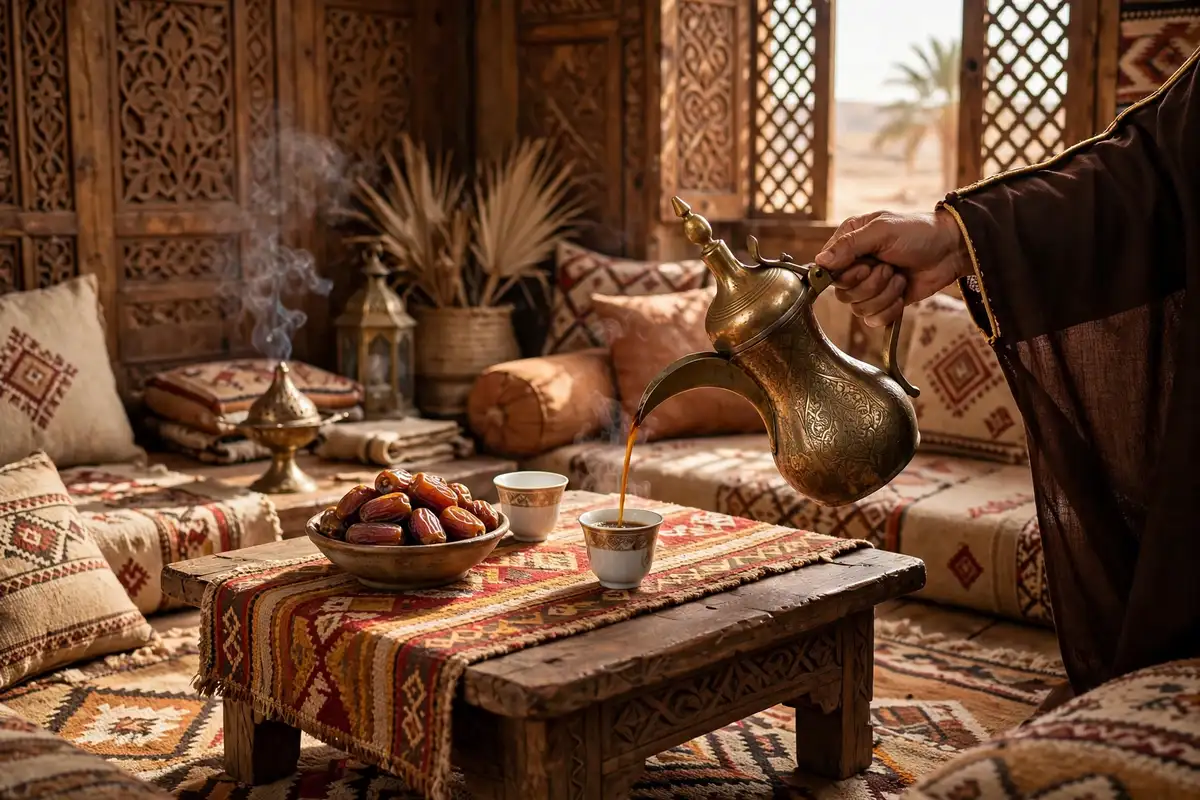
Generosity to guests is the value Saudis name first about themselves, and it has roots in desert survival: a traveller welcomed into a tent was quite literally kept alive by that welcome. Today it shows up as an insistence on feeding you. Expect Arabic coffee — qahwa, lightly roasted and spiced with cardamom — poured in small amounts into a finjan cup from a dallah pot, almost always accompanied by dates. The pourer will keep refilling until you gently shake the cup side to side, the traditional signal that you have had enough. Refusing outright can read as rejecting the welcome; accepting at least a little is the gracious move.
The coffee ritual is so central that it anchors our separate guide to Saudi specialty coffee, and food more broadly — kabsa shared from a communal platter, mandi, jareesh — is covered in our introduction to traditional Saudi food. Meals are social events, often eaten with family or colleagues, and being invited to someone’s home is a genuine honour.
Family, Community and Social Life
Family is the organising unit of Saudi society. Extended families stay closely involved in each other’s lives, Friday gatherings are a fixture, and major decisions — marriages, careers, moves — are typically discussed across generations. Respect for elders is visible in small gestures: standing when an older person enters, greeting them first, and using the right hand for greetings, eating and giving, as the left is considered unclean for social contact.
Greetings matter. “As-salamu alaykum” (peace be upon you), answered by “Wa alaykum as-salam”, is the standard opening; handshakes can be long and unhurried, and among close friends of the same gender, cheek kisses are common. Personal space and physical contact norms differ from Western ones — same-gender warmth, more formality across genders. None of this requires memorising a rulebook; patience, warmth and following your host’s lead will carry you through almost any social situation.
Dress and Modesty
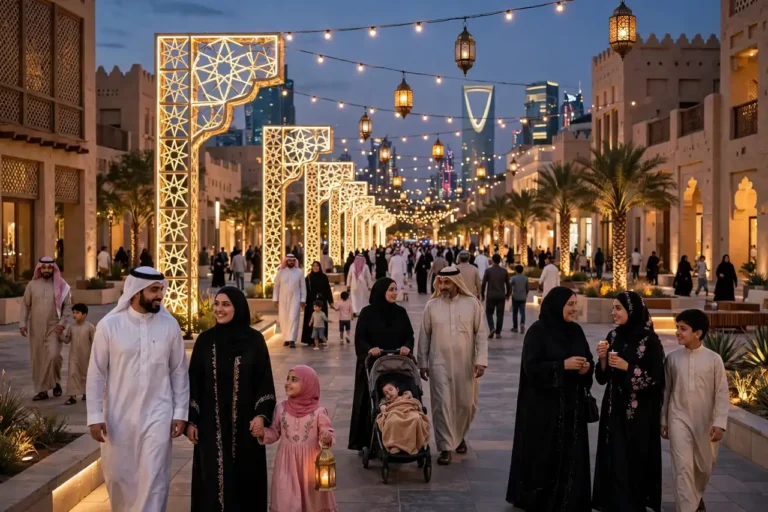
Traditional dress remains everyday wear for most Saudis. Men wear the white thobe with a ghutra or shemagh headdress; women wear the abaya, a flowing black (increasingly, coloured) cloak, with hijab styles varying by region, family and personal choice. Dress is both cultural identity and practical adaptation to the climate.
For visitors, the rule is simple: dress modestly in public — shoulders and knees covered, loose rather than tight clothing — and you will be comfortable everywhere. Since the tourism opening, foreign women are not required to wear an abaya or cover their hair outside religious sites, though many choose a loose scarf in conservative settings or when visiting mosques, where covering is required. Swimwear belongs at beaches and pools, and dedicated beach clubs and resorts have their own norms. Our Saudi Arabia travel tips cover the practical side of this in more detail.
Religion in Daily Life
Saudi Arabia is the birthplace of Islam and home to its two holiest cities, Makkah and Madinah, and faith is woven into the daily rhythm in ways visitors notice immediately: the call to prayer sounds five times a day, many shops and offices pause briefly at prayer times, and the working week and calendar bend around Ramadan, when Muslims fast from dawn to sunset and the country’s social life shifts to the night. Non-Muslims cannot enter Makkah, and Madinah’s central area around the Prophet’s Mosque is restricted, but elsewhere visitors are welcome to appreciate the architecture and atmosphere respectfully from outside.
The year’s great festivals are religious: Eid al-Fitr, the celebration ending Ramadan, and Eid al-Adha, the feast of the sacrifice, are multi-day public holidays of family visits, new clothes, gifts for children and enormous amounts of food. Alongside them sit two national occasions: Saudi National Day on 23 September and Founding Day on 22 February, both marked with concerts, fireworks and public celebrations that have become fixtures of the social calendar.
Heritage, Arts and a Culture in Motion
Saudi heritage is far older than the modern state. Nabataean tombs at Hegra, the mud-brick palaces of Diriyah — the original Saudi capital, now the centrepiece of the Diriyah Gate development described in our Diriyah Gate and Bujairi Terrace guide — and the carved houses of Jeddah’s Al-Balad, covered in our Jeddah Al-Balad guide, all carry UNESCO recognition. Poetry, calligraphy, falconry and camel culture remain living traditions, not museum pieces; the camel festivals and heritage seasons draw enormous local crowds.
At the same time, the culture is visibly in motion. Cinemas have reopened after decades, concerts and international sporting events fill stadiums, women have been driving since 2018, and the AlUla region has been reimagined as an open-air museum — see our AlUla living museum guide. Saudis under thirty — the majority of the population — move easily between the majlis and the music festival. Visitors who arrive expecting a single, static “tradition” usually leave talking about exactly this blend.
Etiquette Tips That Make a Difference
A few practical points round out the picture. Alcohol is strictly prohibited everywhere in the Kingdom — do not bring it, ask for it, or joke about it. Public behaviour is expected to be restrained: loud or rowdy conduct, public displays of affection and photographing people (especially women) without permission are all frowned upon, and photographing government or military sites is prohibited. During Ramadan, be discreet about eating and drinking in public during fasting hours, and accept iftar invitations if they come — breaking the fast with Saudi hosts is one of the warmest experiences the country offers.
Above all, bring curiosity and a little Arabic. Even a few phrases — shukran (thank you), sabah al-khair (good morning) — are received with genuine delight. Saudi Arabian culture rewards the effort to understand it: the coffee is only the beginning.
Explore More of Saudi Culture
Traditions come alive in the Kingdom’s kitchens, festivals and historic towns. Continue exploring here: